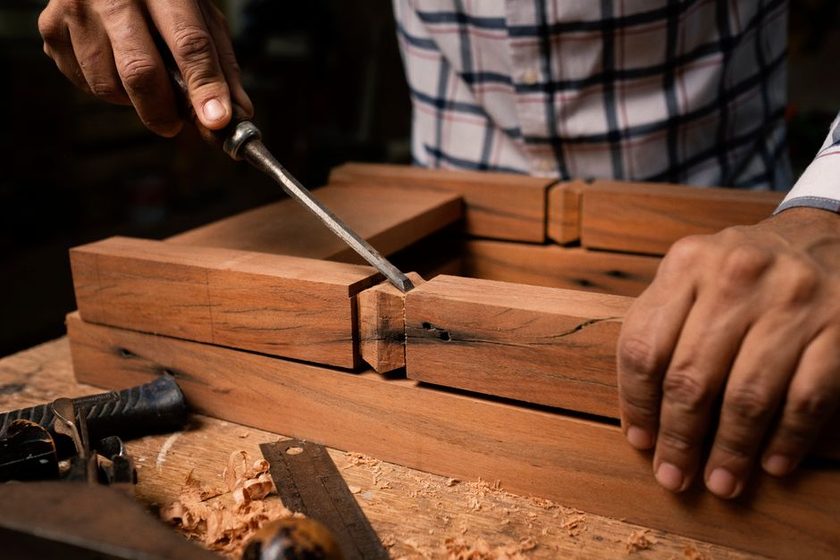
Ask ten woodworkers which joint is stronger, dovetails or dowels, and you will collect ten confident answers and no agreement. That argument belongs on a different page. This one asks a narrower question: before either joint touches a saw or a drill bit, what does the drawing have to get right? A dovetail and a doweled joint tend to fail for almost opposite reasons. One goes wrong when an angle drifts a fraction of a degree across a board's width. The other goes wrong when two centerlines that were supposed to meet, simply don't. Knowing which number carries the risk for which joint changes where attention goes at the drawing table, long before it changes anything at the bench.
The Angle Lives on Paper First
A dovetail's angle is usually set once, on a bevel gauge or a template, from a rise-over-run reference — something in the range of 1:6 for softer stock and 1:8 for denser hardwood is a common shop convention, not a fixed law. That single setting is then walked across every tail on the board. The consequence is worth sitting with: the drawing does not describe several independent angles, it describes one angle, repeated. Get the reference wrong at the gauge and every tail inherits the same error in the same direction, which is often less damaging than it sounds, because a consistent error is at least a predictable one. What the drawing has to nail down is not the angle's elegance but its single point of origin.
The Baseline Both Halves Share
The baseline — the line scored with a marking gauge around the show faces — sets how deep the pins and tails are cut and how the joint sits once assembled. It has to be struck from the same reference face on both the tail board and the pin board, which is really a question about datum faces wearing a joinery hat. Score the baseline from different faces on each half and the two pieces can look perfectly square on the drawing while refusing to close flush on the bench. The baseline is not a detail inside the dovetail drawing; in a real sense, it is the drawing.
Dowels Move the Problem From Angle to Center
A doweled joint removes the angle question entirely — there is no bevel to set, no rise-over-run to transfer. In its place, the drawing has to answer something arguably less forgiving: the exact position of each hole's centerline on both mating faces, and confirmation that those centerlines will actually meet once the boards close. A doweling jig removes some of the guesswork, but only if the reference edge fed into the jig on one board is the same edge used on the drawing for the other. Feed the jig from the wrong edge on just one piece and it will happily repeat a hole position that is consistent with itself and wrong relative to its partner.
A dovetail forgives a sliver of angle error more often than people expect. A dowel forgives almost none of a sliver of center error, ever.
Depth Is a Number You Can Get Wrong Twice
For dowels, depth means the blind hole has to be bored deeper than the dowel pin's length, by a small glue-relief margin, or hydraulic pressure from trapped glue will stop the joint from closing fully under clamp pressure. That is two holes and two depths to get right on every dowel pair, and a cutlist that lists only one depth figure is quietly assuming both holes were bored to it — which does not happen reliably with a hand drill lacking a depth stop. For dovetails, depth resurfaces as the scored baseline: too shallow and the sockets come out undersized; too deep and a visible score line survives on the outside face after assembly, doing to the joint's edge what a stray measurement did to the two-millimeter drawer — a small error nobody drew on purpose, showing up exactly where it can be seen.
A depth stop set against a tape measure and a depth stop set against the actual dowel pin in hand rarely agree by more than a whisker — and a whisker is often the whole margin the joint has to work with. Set it against the part, not the number on the drawing, and re-check it after the first hole is bored, not before the tenth.
Where Each Joint Forgives and Where It Doesn't
Laid side by side, the two joints ask the drawing for different kinds of discipline. Neither list below is longer because the joint is harder to build — it is longer or shorter depending on how many individual numbers the drawing has to keep straight.
| Measurement | Dovetail | Dowel | Margin for error |
|---|---|---|---|
| Angle / centerline | One bevel angle, transferred from a single reference | No angle; a centerline position on each mating face | Dovetail tolerates a fraction of a degree; dowel tolerates almost no lateral offset |
| Baseline / depth reference | Scored line sets socket depth and outer reveal | Blind-hole depth set independently per hole | Both joints fail the same way if the reference face is inconsistent between halves |
| Spacing across the joint | Tail and pin spacing marked directly from the drawing | Hole spacing marked out or set by a jig index | Dovetail spacing errors show as uneven tails; dowel spacing errors show as a twisted glue-up |
| Correction after cutting | Pins can be pared slightly to fit their tails | A drilled hole cannot be moved once bored | Dovetail allows a late, small correction; dowel generally does not |
| Critical dimensions per joint | One angle plus one baseline, repeated down the board | One centerline and one depth, for every single hole | The dowel joint carries more individual numbers, each holding equal weight |
Before either joint reaches the saw or the bit, a drawing worth trusting should already answer four things:
- Which single face on each board the baseline or centerline is measured from — and whether both boards agree on it.
- What ratio or center-to-center distance the angle or hole spacing is based on, and where that number came from.
- How deep the baseline is scored, or how deep each hole is bored, and by what margin relative to the mating part.
- Whether that number has been checked against the actual stock in hand, not only against the plan on paper.
Neither comparison above declares a winner, because the honest answer depends on what a shop is set up to measure accurately and repeat, not on which joint reads as more impressive in a photograph. A shop with one well-calibrated bevel gauge and a habit of striking baselines from a single face will find dovetails predictable. A shop with a doweling jig that is checked against its reference edge every time, and a depth collar that gets reset per project rather than trusted from memory, will find dowels just as forgiving. The joint rewards whichever habit the drawing enforces first.