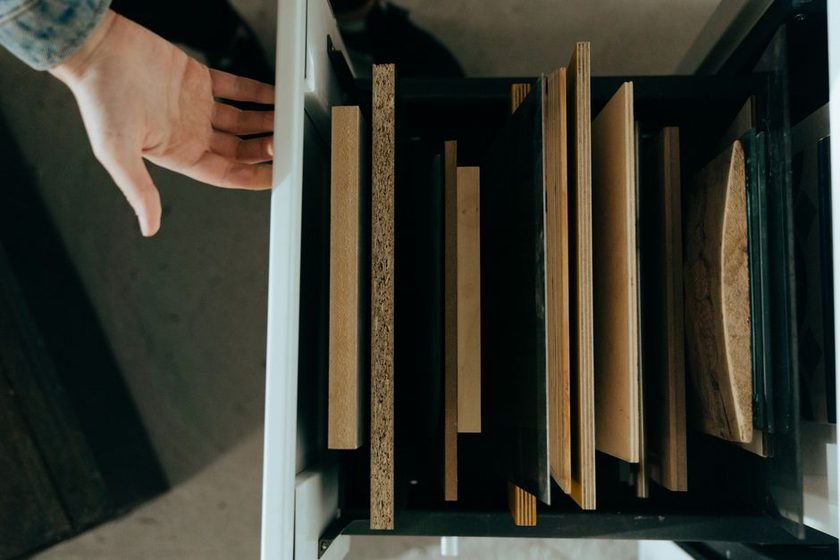
The three drawer fronts in this sideboard came off the saw within a hair of each other — same flitch, same grain match, each cut to the same 200mm width called out on the cutlist. The case they went into was square, the reveal gauge stayed on the bench through the whole glue-up, and the joinery on all three openings was clean. Even so, the gap beside the third drawer front came out two millimeters wider than the other three reveals on the same case, all visible in the same afternoon light. Nothing about the joinery caused that gap. It was decided on paper, in a single rounding habit applied three times in the same direction.
A bank of three, not a clean number
The case is a low sideboard with three equal drawers filling one continuous opening — a common enough layout, and one that looks simple enough to dimension on the back of an envelope. The interior clear width of that opening, fixed once the carcase was glued up, measured 610mm. The design called for a 2mm reveal on each side of the opening and 2mm between each pair of fronts: four gaps in total, or 8mm of reveal subtracted from the 610mm before any drawer front gets a dimension at all. That leaves 602mm to be split evenly across three identical fronts, since the brief asked for a matched set with no visual hierarchy among them. 602 divided by 3 comes to 200 and two-thirds of a millimeter each — a repeating fraction, and not a number a cutlist wants to carry around. A case with two drawers, or four, would have split cleanly into whole millimeters here; three was the one count that couldn't.
Where the fraction got rounded away
On the cutlist, each of the three fronts got the same tidy figure: 200mm, dropped down from 200.667mm because a whole millimeter is easier to strike with a marking gauge and easier to read on a shop drawing than a repeating decimal. It's the kind of decision a drafter makes without a second thought, and made once, it's genuinely invisible — two-thirds of a millimeter is well under what a hand can feel on a board edge. Made three times, in the same direction, on three fronts meant to share one fixed opening, it stops being invisible. Three drops of 0.667mm add up to exactly 2mm, and that 2mm doesn't belong to any single front. It belongs to the case, and the case has to put it somewhere.
What the bench found
The joiner cut all three fronts exactly to the cutlist — 200mm, 200mm, 200mm — and hung them left to right with the reveal gauge set to the specified 2mm for the first gap and each gap between fronts. Nothing in that sequence gave any warning. Each front dropped into its opening at the correct height, sat flush on its runners, and closed with the same quiet action as the other two. By the time the third front went in, the case's fixed 610mm opening had 2mm of width left that the drawing no longer accounted for, and that leftover showed up entirely in the final reveal: 4mm instead of the 2mm used at every other gap on the same case. Three fronts, each individually correct against its own line on the cutlist, and one visibly wrong gap where the arithmetic finally had nowhere left to hide the shortfall.
A rounding error rarely announces itself as an error. It announces itself as the one gap that doesn't match the others.
Carrying the remainder instead of dropping it
The fix isn't a finer pencil. It's deciding, before the cutlist gets filled in, that a shortfall this size doesn't get to hide in whichever gap happens to be last. The method is the same one anyone uses splitting a bill three ways and deciding who covers the extra cent: carry the running remainder forward instead of rounding each share in isolation. Give two of the three fronts 200mm and the third 202mm, or spread it as 201mm, 201mm, and 200mm — either way, the three built widths still sum to the true 602mm the case actually needs, and all four reveals come out even. The only decision left is which front absorbs the extra millimeter, and that's a choice worth making on purpose rather than by accident. It's the same discipline behind reading a case's datum face correctly in the first place — one reference point that every later number gets checked against, so a shortfall gets caught on the drawing instead of at glue-up. It's also why a cutlist should carry the figure a calculation actually produced rather than one someone already rounded for legibility; Reading the Cutlist Before You Touch the Saw covers what a cutlist is actually promising once it leaves the drawing table.
Three places on a typical set of shop drawings tend to invite this kind of early rounding, and it's worth checking each one before a drawing goes out to the bench:
- Any dimension split evenly among more than one identical part, where the division doesn't land on a whole number.
- Any figure copied from one sheet, such as the elevation, onto another, such as the cutlist, instead of being read straight off one running calculation.
- Any reveal or clearance spec derived from a formula and quietly rounded to "a clean number" before it gets multiplied across every gap that uses it.
None of those three habits looks careless in the moment. Each is a reasonable simplification made by someone trying to keep a drawing legible. Checked together, on the same page, before the drawing leaves the table, they're where a second read of the sheet earns its keep.
One rounding, at the end
The sideboard eventually got corrected by re-cutting the third drawer front to 202mm, not by trimming the case stile to hide the gap — a smaller, cleaner fix than it would have been had the mismatch surfaced only after all three fronts were finished and fitted. The general habit worth keeping on the sheet is simple to state and easy to forget under deadline: carry a fraction all the way to the last line before a tool touches the wood, and round once there, never at a step whose result feeds into another sum.
| Stage | What gets rounded | Risk if rounded here | Better practice |
|---|---|---|---|
| Equal division across identical parts | A repeating or non-terminating fraction from dividing a fixed span | Each rounded share drops the same direction; the shortfall lands wherever assembly happens last | Carry the running remainder forward; let one part absorb the leftover on purpose |
| Copying a figure between sheets | An elevation number re-entered on the cutlist | Two people round the same fraction independently, the same direction | Reference one source figure, not a re-typed value |
| Reveal or clearance spec | A calculated allowance rounded to "a clean number" | The rounding repeats in every opening that uses that reveal | Round the spec once; note the true value beside it |
| Final layout mark | The dimension a gauge or tape actually registers | Nothing downstream left to compound | This is the only point where rounding is safe |
Read also
- Tolerance Stacking in Flat-Pack Furniture — the same compounding problem, seen across a whole run of panels instead of three drawer fronts.
- The Drawing That Saves More Timber Than Technique — why the sheet catches what skill alone catches too late.
- Squaring a Carcase Without a Jig — another case where the bench simply reports what the drawing already decided.