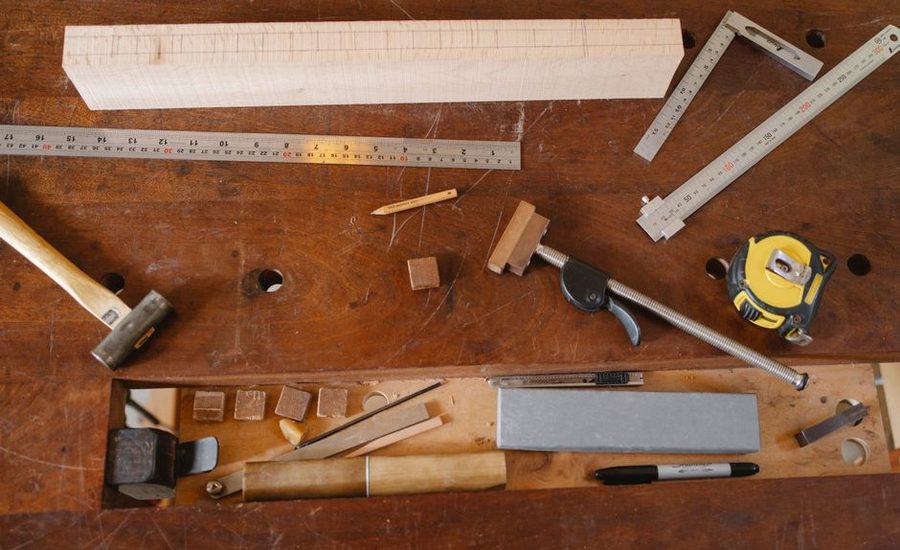
The idea came from a throwaway line in a supplier's catalogue copy: set it once, work all week. I decided to test it properly rather than take it on faith. On Monday morning I pulled the reveal dimension for a bank of five drawer fronts off the cutting list, set a single marking gauge to that number, and ran a strip of tape across the locking screw so I'd notice the moment it drifted. The rule for the week was simple: no resetting the beam until every drawer in the run was scribed, no matter how many boards or joints stood between the first mark and the last.
Monday — one setting, read from the drawing
The habit I was trying to break was reading a gauge off the stock in front of me — eyeing a reveal, nudging the fence, calling it close enough. Instead the setting came straight from the elevation, the same number that had already been checked against the carcase opening before anything was cut. Reading the dimension off a drawing rather than off a board is a small discipline, but it's the same one covered in the drawing that saves more timber than technique: the number is decided once, on paper, where a mistake costs nothing but an eraser.
Tuesday — where the discipline paid off
By Tuesday afternoon I'd scribed shoulder lines on all five drawer rails from the same locked setting. Laid side by side, the lines sat exactly level with each other — no board reading a hair proud of its neighbor, no shoulder that needed a second pass with a chisel to bring it in line. That's the payoff of holding one setting: every mark inherits the same error, or the same absence of one. A gauge reset five times can drift five different ways; a gauge locked once can only be wrong once.
A gauge doesn't know the right dimension. It only knows how to repeat the one you gave it — faithfully, joint after joint, whether that number was correct or not.
Wednesday — the joint that broke the rule
The rule held until a stopped housing on the case side, where two boards milled from different stock ran a half-millimeter apart in thickness. Riding the gauge off the same face on both boards, as the setup called for, put the housing line a fraction off true on the thinner piece. This is the gap that datum faces exist to close: the gauge was consistent, but consistent against a face that wasn't reading the same thickness on both boards. I reset for that one joint and marked why in the shop log, rather than pretend the week had gone perfectly.
A marking gauge removes exactly one kind of error: the error of reading a rule slightly differently each time you pick it up. It does nothing about a dimension that was wrong on the drawing, or a board that isn't the thickness the drawing assumed. Those are separate problems, solved earlier, on paper.
Thursday — two gauges, not one
The fix for Wednesday's housing turned out not to be resetting the same gauge back and forth, but keeping a second gauge dedicated to that one dimension for the rest of the week. The single-setting idea survived, just narrower than I'd first framed it: not one gauge for the whole project, but one setting per feature, held for that feature's full run. Logged against the days, the pattern was clear enough to write down.
| Day | Joint | Setting source | Outcome |
|---|---|---|---|
| Monday | Drawer front reveal | Elevation drawing | Setting locked, no resets |
| Tuesday | Rail shoulders (5) | Same locked gauge | All shoulders level |
| Wednesday | Stopped housing | Same gauge, wrong face read | Reset required, logged |
| Thursday | Housing, second board | Dedicated second gauge | Consistent from here on |
| Friday | Tenon cheeks | Cutlist thickness, third gauge | No resets, no surprises |
Friday — what the gauge can't fix
By the end of the week the lesson wasn't really about the tool. A gauge enforces whatever decision was already made; it has no opinion on whether that decision was right. If the drawing had given the wrong reveal on Monday, a perfectly held setting would have repeated that error across all five drawers with total consistency — which is worse than an inconsistent error, because nothing about the work would have looked wrong. The gauge is a technique-side safeguard. The dimension it's set to is a drawing-side decision, and that's where checking belongs, before the beam ever locks.
- Read the setting off the drawing or cutlist, not off a convenient board.
- Lock one setting per dimension, not per project — a second feature earns a second gauge.
- Mark which face the gauge is riding, and confirm every board shares that face as a true reference.
- Log a reset when it happens; a silent reset is the one that comes back as a gap later.
This is a record of one week in one shop, not a universal method. Stock variance, joint type, and how a drawing was dimensioned will all change whether a single setting holds. It's offered here as a log, not a rule to copy without checking it against your own cutlist.